
Mission/Vision
Big Hearts of Fox Valley is a 501(c)(3) nonprofit organization dedicated to supporting children and families within School District 303 who are facing financial challenges. Through compassionate community efforts, we provide essential assistance during key moments of the year—enhancing holidays, easing back-to-school transitions, ensuring warmth in winter, and offering year-round support. Our mission is to alleviate family stress, foster hope, and empower the youth in our community for a brighter future.
Our vision is a community where every child feels supported, every family feels hopeful, and no one faces hardship alone. We strive for a future where compassion connects us, and all children in D303 have the opportunity to thrive—regardless of financial circumstance.
Children We Serve
Improving the Lives of Children in Community School District 303
Big Hearts of Fox Valley is a 501(c)(3) nonprofit organization dedicated to supporting children and families within School District 303 who are facing financial hardship.
To ensure our resources reach the families who need them most, all referrals are made directly by D303 school social workers—those who know these students’ challenges best.
[read more]
We proudly serve all 15 D303 schools, which together support approximately 12,000 students from pre-kindergarten through 12th grade. In addition, we extend care to their younger siblings who are not yet school-aged.
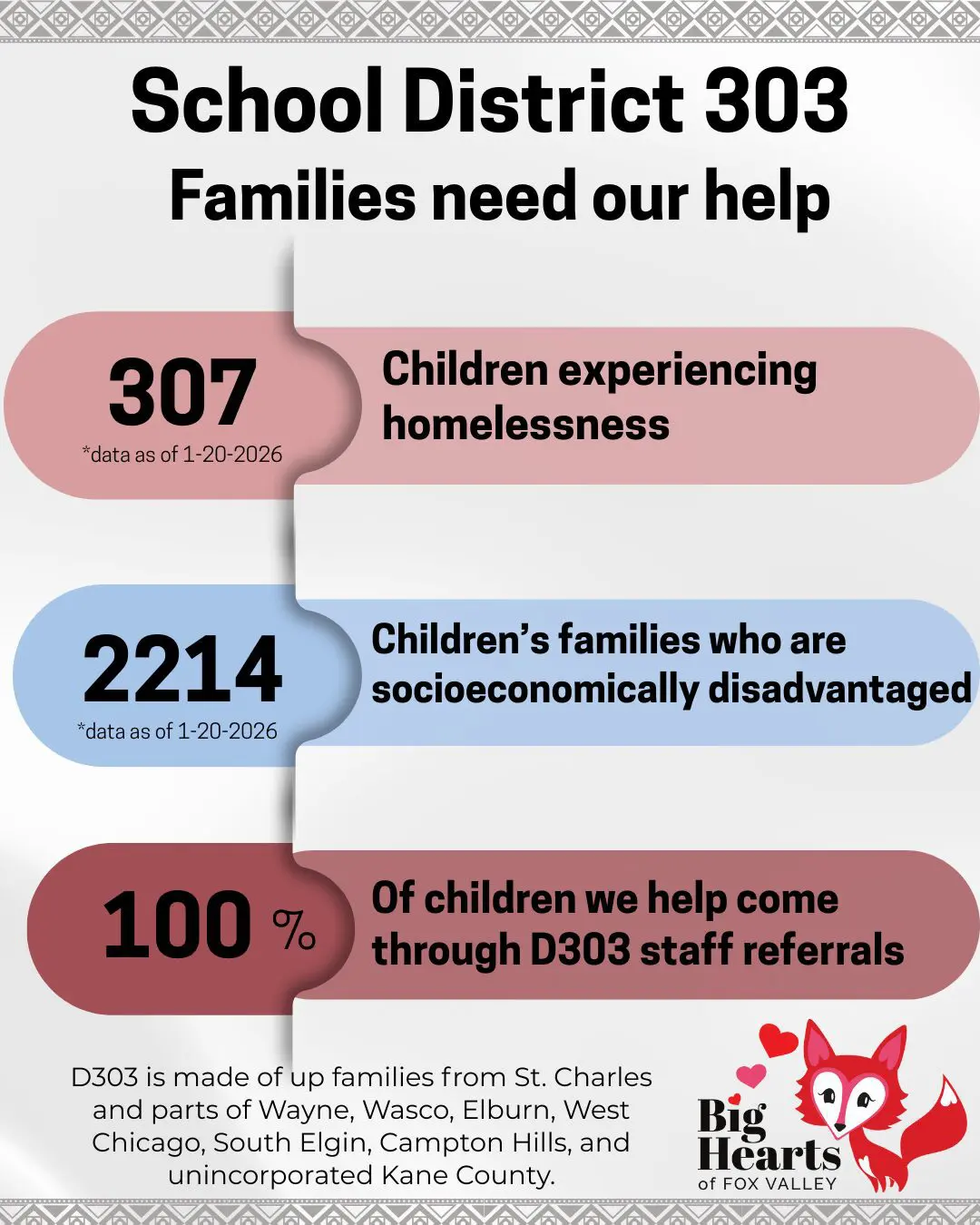
District 303 spans 57.4 square miles in the Fox River Valley, encompassing the city of St. Charles and parts of Wayne, Wasco, Elburn, West Chicago, South Elgin, Campton Hills, and unincorporated Kane County.
The majority of families we assist are experiencing homelessness or are below ALICE households.
Homeless/Mckinney-Vento
Children and youth who lack a fixed, regular, and adequate nighttime residence, including children and youth who are:
- Sharing the housing of other persons due to loss of housing, economic hardship, or a similar reason.
- Living in motels, hotels, trailer parks, or camping grounds due to lack of alternative adequate accommodations.
- Living in emergency or transitional shelters.
- Abandoned in hospitals.
- Children and youth who have a primary nighttime residence that is a public or private place not designed for, or ordinarily used as, a regular sleeping accommodation for human beings.
- Children and youth who are living in cars, parks, public spaces, abandoned buildings, substandard housing, bus or train stations, or similar settings.
- Migratory children who qualify as homeless because they are living in circumstances described above.